A Simple Way to Fold a Fitted Sheet
Control the elastic corners first, then make a neat rectangle.

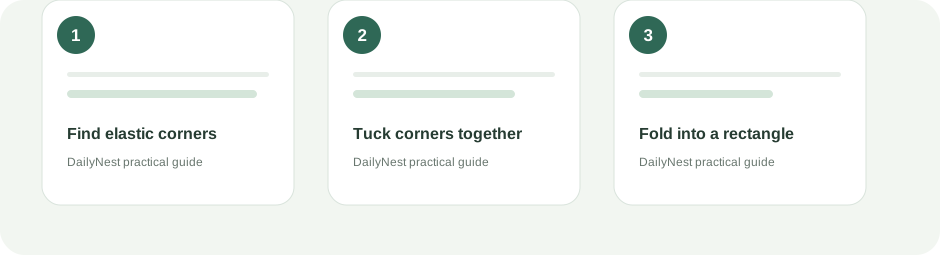
Control the elastic corners first, then make a neat rectangle. The best approach depends on the materials, products, and conditions in your home. Start with the instructions for the specific item you are working with and make a small compatibility check before proceeding.
Step-by-step approach
- Hold two adjacent corners with the elastic edge facing you
- Tuck one corner over the other
- Gather the remaining corners into the same bundle
- Lay the sheet on a flat surface
- Fold the curved edges inward and finish into thirds
Fitted sheets feel awkward because their elastic edges gather the fabric.
Hold two adjacent corners and tuck one over the other.
Repeat with the remaining corners so the elastic is gathered into one set of corners.
Lay the sheet on a bed, smooth it into a rough rectangle, fold the curved sides inward, and finish into thirds or quarters to suit the shelf.
Store matching pieces together inside a pillowcase.
Use a clean, dry surface. Do not pull hard on elastic or force fabric that is twisted. Fold bulky bedding loosely enough to avoid crushing delicate fibers.
Use the corners as the structure
Hold the sheet with the elastic edge facing you and identify the four corners. Tuck one corner into another so the elastic edges nest together. Repeat with the remaining corners until the sheet forms a smaller, more regular shape. Keep the fabric smooth as you bring the corners together.
Troubleshooting and common mistakes
Lay the nested shape on a flat surface and fold the curved elastic edges inward to make a rectangle. Fold the rectangle into thirds or quarters to match the shelf height. The exact number of folds depends on sheet size and fabric bulk; prioritize a stable, compact bundle rather than a perfect geometric shape.
When to stop and get help
If the corners keep slipping, work on a bed or table instead of holding the sheet in midair. Store matching pillowcases with the sheet set so the complete set is easy to retrieve.
Adjust the fold to the shelf
Deep fitted corners and thicker fabrics create more bulk. Rather than forcing every sheet into the same dimensions, make a bundle that sits flat and can be lifted without unfolding. Store the matching pillowcases with it so the set remains together.
Frequently asked question
Does this method work for every sheet size?
The corner-tucking method works as a general approach, but the final bundle will vary with mattress depth, elastic design, and fabric thickness. Use a flat surface and adjust the number of folds to suit your shelf.
Editorial note: This is general household information. Product instructions and official safety guidance take priority where they differ.